
 Use cases
 Messaging
 Taxi Companies
 Private Transport
 Transportation Entrepreneurs
 Last Mile
 SuperApp
 Software
 Taxi dispatch
 Corporate transportation
 Auction
 Products
 Booking Software
 Dispatch Platform
 Driver App
 Passenger App
 Web Widget
 Functions
 Schedule & Booking
 Driver Management
 Custom
 Corporate Portal
 Security & Support
 Resources
 Learn
Learn



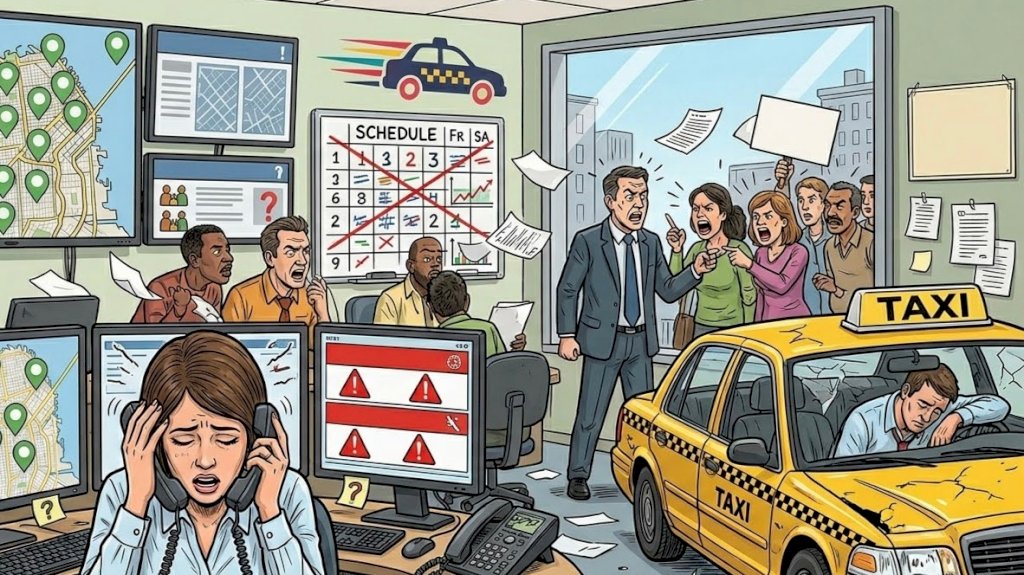
Technological change is set to be a key factor in the success of taxi businesses by 2026. Adopting platforms for managing taxi companies is essential. Customers expect a seamless experience, with options to request a ride, make payments, and rate the service through their smartphones.
In fact, Artificial Intelligence (AI) can optimize operations, from vehicle allocation to demand forecasting. Businesses that adopt a taxi dispatch system can reduce operating costs and increase vehicle availability.
A taxi business that effectively adopts and integrates these technologies will be better positioned to thrive in 2026. Constant innovation and the ability to adapt to evolving consumer expectations will be key to success in an increasingly competitive environment. In this article, we identify some critical pitfalls that could impact your profitability.
A taxi business no longer just competes with other drivers
Digitalization has gone from being a competitive advantage to a necessity for survival. Managing taxi fleets based on "intuition" or paper records creates blind spots. The lack of real-time data makes it impossible to react to changes in demand, fuel leaks, or risky driver behavior.
Dependence on manual processes and "radio dispatch"
It's a major mistake to continue assigning trips via voice or group chats in 2026; dispatching must be silent and automated. Reliance on manual processes and the use of radio dispatch can be considered significant errors in taxi company management.
Manual management often lacks systems that provide real-time data on fleet status, driver availability, and passenger demand. This hinders informed decision-making and can result in missed opportunities.
To mitigate these problems, taxi companies can consider adopting technology that enables automatic trip allocation, performance tracking, and real-time data collection. They can also offer apps for both drivers and passengers to facilitate communication and improve the user experience.
By addressing these errors and adopting a more modern and technological approach, taxi companies can significantly improve their operational efficiency and customer service.
Ignoring the driver's "life cycle"
Failing to consider the characteristics and needs of drivers can lead to poor selection. Ignoring the driver lifecycle means that opportunities for ongoing training or professional development may not be offered, which can negatively impact job satisfaction and driver motivation.
To address this problem, taxi companies may consider implementing an onboarding process that helps new drivers adapt quickly and feel part of the team.
By considering the driver lifecycle, taxi company management can improve not only staff satisfaction and retention, but also the quality of service offered to passengers, resulting in better overall business performance.
Lack of preventive maintenance control
The lack of preventative maintenance control is a critical error in taxi company management, one that can have multiple negative consequences. Ignoring preventative maintenance can lead to more costly repairs in the long run.
Vehicles that are not properly maintained are more prone to mechanical failures. This not only jeopardizes the safety of drivers and passengers but can also result in accidents that damage the company's reputation.
To mitigate these problems, taxi companies can create a regular schedule for preventative maintenance that includes periodic checkups, oil changes, brake inspections, wheel alignment, and other critical aspects. However, by implementing taxi management software, they can keep a detailed record of the maintenance performed, schedule reminders for upcoming checkups, and monitor the overall condition of each vehicle.
Static rates versus dynamic demand
Fare management in a taxi fleet is a crucial aspect that can significantly influence the profitability and sustainability of the business. Implementing static fares in a dynamic demand environment can be a critical mistake in optimizing taxi operations.
Static fares don't adjust to fluctuations in demand, which can lead to an oversupply or undersupply of taxis. By not adjusting fares according to demand, companies may miss opportunities to maximize revenue. During periods of high demand, dynamic pricing could allow taxi companies to capture more value for their services.
To address these problems, taxi companies may consider adopting a dynamic pricing model, as well as implementing technological systems that monitor demand in real time and automatically adjust fares accordingly.
Transparency can help mitigate customer dissatisfaction. By adopting a more flexible, data-driven approach to fare management, taxi companies can improve their competitiveness, increase revenue, and provide better service to their customers.
A successful taxi company today requires good management
The mistakes described here are common, but in today's competitive landscape, they are unsustainable. Transitioning to comprehensive software isn't an administrative expense; it's the support your company needs to scale and regain control of its profitability. Don't wait for the competition to overtake you. Start managing your taxi business correctly today . Discover how to boost your business with ToolRides.