
 Use cases
 Messaging
 Taxi Companies
 Private Transport
 Transportation Entrepreneurs
 Last Mile
 SuperApp
 Software
 Taxi dispatch
 Corporate transportation
 Auction
 Products
 Booking Software
 Dispatch Platform
 Driver App
 Passenger App
 Web Widget
 Functions
 Schedule & Booking
 Driver Management
 Custom
 Corporate Portal
 Security & Support
 Resources
 Learn



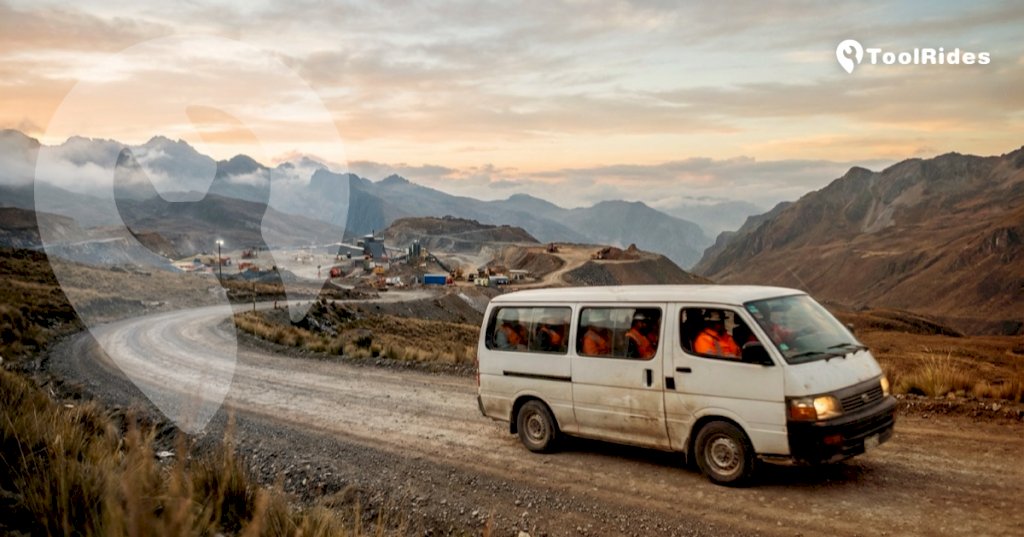
If your company runs mining employee transportation, or moves staff for industrial plants and agribusiness, you know contracts are won on price and kept on evidence. The mine's logistics team wants to know that the 5:00 a.m. van left at 5:00, which driver and vehicle covered it, and that the route cost what the invoice says. Many of the operators who contact us move crews to remote sites with sedans, 4x4s, vans and buses, and describe the same burden: paper route sheets and a month-end reconciliation that takes days. This guide explains how to organize the operation with software.
What mining employee transportation requires: client and regulation
The market is large and growing. In Peru, direct mining employment passed 270,000 jobs in 2025, a record according to Ministry of Energy and Mines data reported by the state agency Andina. Every shift change means hundreds of people moving between town, camp and pit.
In Peru, staff transport falls under the national land transport regulation, Supreme Decree 017-2009-MTC, and the employer keeps its duty of prevention under Law 29783 on Occupational Safety and Health. That is why the mine passes its own requirements to the contractor: licensed drivers with a clean record, vehicle checks, speed limits and driving hour rules. In practice each mine has an internal traffic regulation the contractor signs.
- Fixed routes and times per shift, with a contract start and end date.
- Proof of punctuality for every trip, for the contract's service indicators.
- Cost allocation by cost center: the camp route is charged to one department and the city office shuttle to another.
- Incident reporting: changes of vehicle or driver, cancellations and rescheduled trips.
- Driver and vehicle documents ready for the client's audits.
From paper route sheets to scheduled trips
The unit of work is the shift route: Shift A, camp to plant, Monday to Saturday, 5:00 a.m., 15 passengers, van with a given plate and driver. In transportation software each of those trips is a scheduled trip with the driver already assigned. Instead of typing them one by one, the week's trips can be loaded in bulk from an Excel file, as explained on the service import page.
The driver sees the trip in the app, starts it and closes it on arrival, so the actual time is stored next to the planned time. The mine's supervisor can follow the vehicle with a shareable link without access to your company panel.
Unplanned trips, such as an airport run for an engineer who is flying out, come through the client's corporate portal. An authorized user at the mine requests it, a manager approves it if the policy requires, and the system assigns it and charges it to the right cost center. The same logic applies to corporate transportation contracts in any sector.
The indicators the system should produce without manual work
| Contract indicator | Source data in the system | Typical frequency |
|---|---|---|
| Departure and arrival punctuality | Planned time against start and end time recorded by the driver | Daily, consolidated monthly |
| Kilometers per route and vehicle | GPS track of every trip | Monthly, for costing and maintenance |
| Cost per cost center | Trip fare linked to the client's department | Monthly, in the account statement |
| Incidents | Driver or vehicle changes, cancelled or rescheduled trips | Per event and monthly summary |
Which metrics to prioritize as the fleet grows is covered in key metrics for corporate transportation.
Example: 28 vehicles, two mines and one plant
A company in southern Peru runs 28 vehicles for two mining operations and an industrial plant: 46 fixed routes a day across three shifts, plus about 40 ad hoc trips a month.
With paper route sheets, the back office spends four to six days closing each month. It rebuilds trips, matches them against contracts and issues three statements, and any client query reopens the process.
With routes loaded as scheduled trips, each client's statement is ready on the first business day with detail by route and cost center. A query is answered with the start time and GPS track of the trip in question. At an administrative cost of USD 60 per person-day, that removes USD 240 to USD 360 of closing work every month. More important, the invoice is paid in full and on time.
Where ToolRides fits
ToolRides manages client companies with departments, cost centers, authorized users and trip approval. It also handles scheduled trips with automatic dispatch, bulk import of trips and of client employees from a file, credit-based corporate payment, and period billing for each company. The corporate account portal lets the mine request and review its own trips.
Driver management stores documents and expiry dates per driver and vehicle, which makes contractor audits easier. Real-time tracking and reports cover the indicators in the table. The admin panel, driver app and passenger app run under your brand, so the mine sees your company, not a software vendor.
Two limits to be clear about: ToolRides does not issue tax e-invoices, it produces the statement you invoice from, and it does not manage vehicle maintenance, although it records the kilometers per unit that feed that plan.
Frequently asked questions
Can I charge each client a different price for the same route?
Yes. Fares are set per client company, so the same route can carry one price in the contract with mine A and another with plant B.
Does the mining client need access to our system?
Not to your company panel. The client gets its own corporate portal, limited to its departments and trips, where it requests, approves and reviews services, plus a tracking link for each trip.
Does it work for long routes from town to camp?
Yes. Scheduled trips have no distance limit, and the GPS track records kilometers and hours, which are the basis for costing and for the driving hour checks in the mine's internal rules.
How do I load hundreds of employees and routes at the start?
Client employees can be imported from a file with their department and cost center, and trips can be imported in bulk from Excel, so the setup does not depend on typing every record.